Initiate, Develop & Expand business through us

Please wait...
Initiate, Develop & Expand business through us
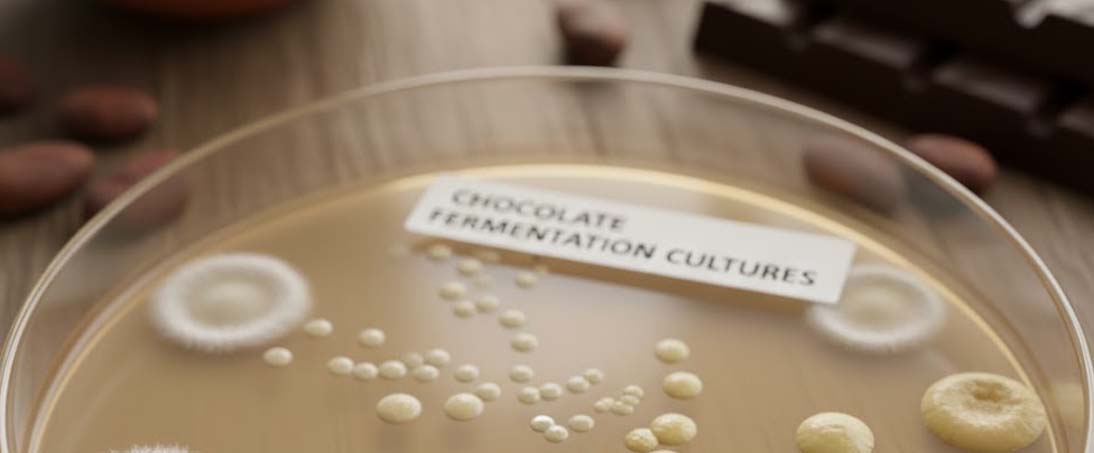
Chocolate is one of the most appreciated and loved sweets all around the globe. It comes in all shapes and sizes as dips. There are not many people who despise chocolate and all of its magnificent forms. Chocolates come from cacao beans, and in the process of obtaining chocolate from these beans, various microscopic beings play a vital role.
Microorganisms are essentially important in the process of fermentation of cacao beans and are found in the fermentation mass, which constitutes the contents of a cacao tree pod. This includes the beans and pulp, which is sweet and mainly consists of carbohydrates (glucose, fructose and sucrose). Initially, the fermentation mass is mostly anaerobic in nature and has a quantity of citric acid present. This condition is optimal for the growth of yeasts such as Hanseniaspora guilliermondii, Pichia kudriavzevii and Kluyveromyces marxianus. These organisms produce alcohol, ethanol, by fermenting the sugars anaerobically. But, ethanol is in turn, lethally toxic to them. Thus, as the concentration of ethanol increases, the yeasts decline rapidly.
The yeasts produce volatile compounds which give chocolate its distinctive aroma and flavour. Additionally, they break down and digest the pulp to a liquid (broth), which increases the aeration in the fermentation mass. After the yeasts start to decrease, the lactic acid bacteria like Lactobacillus plantarum and Lactobacillus fermentum show their capability of withstanding high concentrations of acids (aciduric bacteria). They produce large amounts of citric and lactic acid, hence making the fermentation mass more acidic. After the fermentation mass reaches the temperature of 37°C, it is highly acidic and well aerated with a good amount of oxygen.
Acetic acid bacteria, like Acetobacter pasteurianus and Gluconobacter frateurii, metabolise the ethanol present to form acetic acid. They further break it down into carbon dioxide and water. Being an exothermic reaction, this causes the temperature of the fermentation mass to increase to 50°C. This further leads to the diffusion of caffeine, polyphenols and theobromine from the beans, thus ensuring that the beans do not germinate.
The last stage of the fermentation process is what gives the cacao beans a bitter taste. After fermentation, the beans are sun-dried, which kills off most of the microorganisms. This ensures that the consumer gets to taste the flavourful and aromatic chocolate that everyone appreciates and enjoys.
Keywords: Fermentation, Anaerobic, Yeasts, Lactic acid bacteria, Aerobic, Acetic acid bacteria
Image source:
Image generated using Google Gemini (AI).
Citation:
Harleen Kaur Paul. Microorganisms that play a key role in the production of chocolate. The Torch. 2023. 4 (31).
Available from: https://www.styvalley.com/pub/magazines/torch/read/microorganisms-that-play-a-key-role-in-the-production-of-chocolate/.
Article counter:
The article has been read 112 time(s)