Initiate, Develop & Expand business through us

Please wait...
Initiate, Develop & Expand business through us
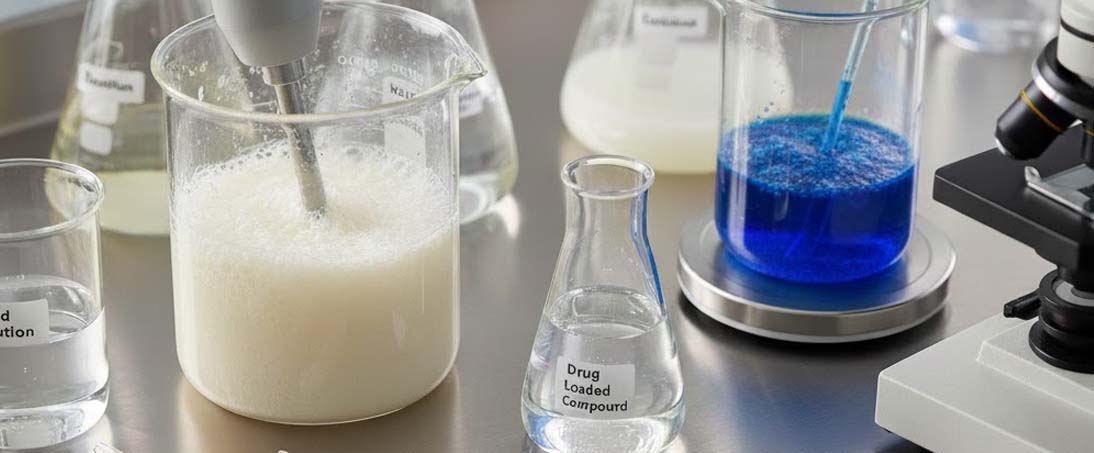
Liposomes have been used extensively in research as gene carriers for transfection experiments over the years. One of the many methods used to encapsulate the genetic material in liposomes is the solvent dispersion method. There are three types of solvent dispersion methods, and they are ether injection, ethanol injection and the reverse-phase evaporation method.
In the ether injection method, using diethyl ether or ether-methanol, a solution of lipids is prepared. Then, into an aqueous solution of the encapsulated genetic material, this solution is slowly injected at a temperature range of 55-65°C. As a consequence of the removal of the organic solvent using a vacuum, liposomes are produced. The liposomes produced using this technique are heterogeneous, with the diameters of the liposomes ranging from 70 to 200 nanometres.
For the ethanol injection method, a solution of the lipid is prepared in ethanol. This solution is then injected into huge volumes of a particular buffer containing the genetic material to be encapsulated. With this method, it is difficult to get rid of the ethanol to obtain the liposomes. Moreover, the population of liposomes is heterogeneous in the sense that the diameters of liposomes range from 30 to 110 nanometres.
With the reverse-phase evaporation method, it has become possible to create liposomes that have a high aqueous space-to-lipid ratio. Thus enabling the liposome to enclose large amounts of the aqueous solution of the substance to be encapsulated. In this technique, inverted micelles are generated by using an aqueous solution of the genetic material and an organic phase. Sonication is then used to dissolve the lipid molecules. Gradual removal of the organic phase converts the inverted micelles into a gel. Excess phospholipids in the environment surround the inverted micelles to form a bilayer structure, eventually leading to the formation of liposome structures.
The process of sonication may need to be carried out carefully to prevent the denaturation of DNA and proteins. A convenient method for the preparation of liposomes can hence be chosen, based on the availability of materials and facilities in the laboratory and the required characteristics of liposomes.
Keywords: Liposomes, Passive loading, Solvent dispersion, Organic solvent, Encapsulation
Image source:
Image generated using Google Gemini (AI) and modified by The Torch Editorial team.
Citation:
Mahekdeep Rai. Solvent dispersion for liposome preparation and loading
. The Torch. 2023. 4 (26).
Available from: https://www.styvalley.com/pub/magazines/torch/read/solvent-dispersion-for-liposome-preparation-and-loading/.
Article counter:
The article has been read 132 time(s)